
Camel Spider in Dubai: Identification, Dangers & What To Do
⚡ Quick Answer : Camel spiders are not venomous and do not chase humans. However, they deliver a painful bite that can cause bacterial infection, and their presence in your home often signals a wider pest problem. If you’re seeing them repeatedly in your Dubai property, a professional inspection is the right next step.
If you live in Dubai or anywhere in the UAE, chances are you have heard spine-chilling stories about the camel spider. With its imposing size, lightning speed, and powerful jaws, the camel spider (scientifically known as a solifugid) has earned a fearsome reputation that stretches far beyond the desert dunes. But how much of that reputation is fact, and how much is fiction?
At Pest Control Dubai AE (pestcontroldubai.ae), our experts encounter all manner of pests across Dubai’s residential villas, commercial properties, and desert-adjacent communities.
In this comprehensive guide, we separate myth from reality, explain everything you need to know about camel spiders in the UAE, and tell you exactly what to do if you encounter one in or near your home.
What Is a Camel Spider?
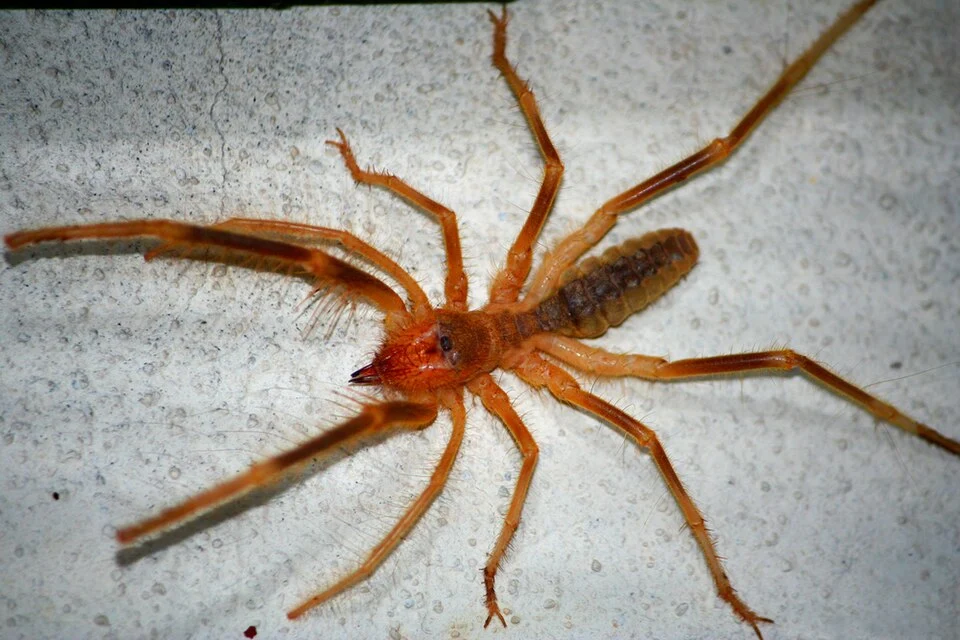
Credit: Siamaksabet / Wikimedia Commons / CC BY-SA 3.0
Despite the name, camel spiders are neither true spiders nor scorpions. They belong to the order Solifugae a distinct group within the class Arachnida. Other names include wind scorpion, sun spider, and in Arabic: Abu Dabyah (أبو دبيه).
Like spiders they have eight legs, but they lack venom glands entirely something even most true spiders possess. They are purely mechanical predators: fast, powerful, and built for the desert.
Scientific Classification
In the UAE, three main families are found:
The most widespread; long-legged, sandy-coloured. Includes Galeodes arabs, the largest UAE species, with a leg span up to 150mm.
Similarly light-coloured and adapted to sandy terrain; common across Dubai’s desert fringes.
Black-coloured, shorter legs, better adapted for digging; more prevalent near Al Ain and mountainous terrain.
(Galeodes arabs)
What Do Camel Spiders Look Like?
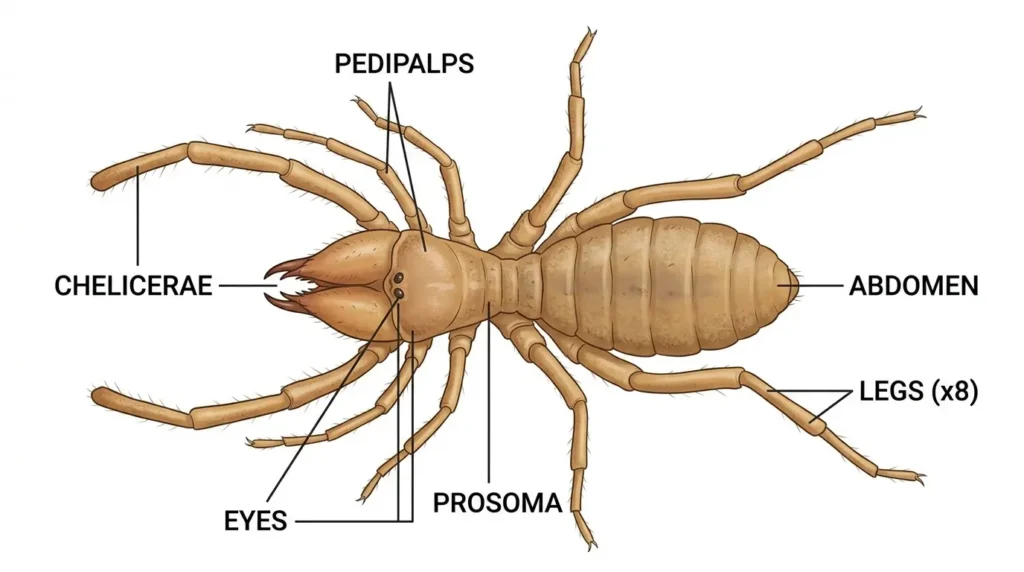
Size: Typically 4 to 6 inches in total length including legs though photos often exaggerate their size due to perspective
Color: Sandy-brown, tan, or beige, perfectly camouflaged against desert terrain
Body: Divided into two sections — the large, flattened prosoma (front) and the abdomen (back)
Legs: Eight long, hair-covered legs used for rapid movement
Chelicerae (jaws): The most distinctive feature — massive, powerful pincers that can be up to one-third of their total body length
Pedipalps: Two additional appendages near the mouth that act like antennae for sensing prey
Eyes: Multiple small eyes on the sides of the body
How to Identify a Camel Spider in Dubai
Camel spiders are often misidentified — people frequently mistake them for large spiders, scorpions, or even small crabs in a panicked moment. Here is a clear identification guide:
| Feature | What to Look For |
|---|---|
| Size | Body 3–7 cm; total leg span up to 15 cm in large specimens. Perspective in photos often makes them appear much larger. |
| Colour | Sandy tan to light brown — perfectly camouflaged against desert and sandy soil. |
| Legs | 4 pairs total, but runs on only 3; the front pair (pedipalps) are held upright like antennae. |
| Jaws (chelicerae) | Enormous — up to ⅓ of total body length; the most distinctive feature. Used to crush and liquefy prey. |
| Movement | Extremely fast and erratic; sprints in sudden bursts then freezes. |
| Eyes | Two prominent forward-facing eyes; does not spin webs. |
| Sound | Can make a faint hissing or stridulating sound when threatened. |
If the creature you saw had massive pincers at the front, ran in a straight line at high speed, and was sandy-brown in colour — it was almost certainly a camel spider. Regular spiders move slowly; camel spiders sprint. If it left you in shock at how fast it moved, that’s your identification right there.
Myths vs. Facts — The Truth About Camel Spiders
The camel spider became an internet sensation in the early 2000s when exaggerated stories and doctored photos spread during the Gulf War. Many Dubai residents still believe these myths. Let’s set the record straight:
| ❌ The Myth | ✅ The Fact |
|---|---|
| They run at 30 mph and can outrun a human | Their top speed is about 16 km/h (~10 mph) — fast for an arthropod, but not superhuman. The 30 mph claim was fabricated. |
| They are venomous and inject anaesthetic | Camel spiders have zero venom glands. This is biologically confirmed. There is no anaesthetic — the sleepy-soldier stories are entirely false. |
| They are half the size of a human | The viral photo used a forced-perspective technique. Adults grow to around 15 cm across — frightening enough without exaggeration. |
| They actively chase humans to attack | When they appear to chase a person, they are running toward the shadow the person casts — seeking shade from desert heat. They have no interest in humans. |
| Their bite causes flesh to rot or liquefy | They do liquefy prey with digestive fluids before consuming it — but this does not occur in a defensive human bite. The bite wound is mechanical only. |
| They eat camels’ stomachs while they sleep | Completely false. They eat insects, scorpions, small lizards, rodents, and small birds. Not camels. |
Are Camel Spiders Dangerous? Bite Risk & First Aid
“Not venomous” does not mean “harmless” — and this distinction matters for Dubai residents.
The Bite: What Actually Happens
Camel spiders possess extremely powerful chelicerae (jaws). When threatened or cornered, they can and will bite. The bite is purely mechanical — no venom is involved — but their jaws are strong enough to break human skin and cause a sharp, deep wound.
Reported effects of a camel spider bite include sharp localised pain, redness, swelling around the wound site, and — if not treated promptly — secondary bacterial infection, which is the primary medical risk.
1. Clean the wound thoroughly with soap and water for at least 60 seconds.
2. Apply an antiseptic (Dettol, Betadine, or hydrogen peroxide).
3. Cover with a clean bandage.
4. Monitor for 24–48 hours for spreading redness, increasing swelling, heat, or discharge — these are signs of bacterial infection.
5. See a doctor if symptoms worsen. Seek emergency care if you experience an allergic reaction (rare).
Risk to Pets
Cats and dogs are naturally curious and will investigate a camel spider — putting their nose or paw right where the jaws are. Even a non-venomous bite can cause significant pain, swelling, and distress in pets. If your pet has been bitten, contact a vet promptly.
Legal Note: UAE Protection Status
Under UAE Federal Law No. 24 of 1999, it is illegal to collect camel spiders from the wild. The Environment Agency Abu Dhabi (EAD) monitors their populations. A licensed pest control company will handle them within the boundaries of UAE environmental law — something important for property managers and resort operators to be aware of.
Where Are Camel Spiders Found in Dubai?
Camel spiders are desert-adapted creatures, but Dubai’s rapid urban expansion into desert land has dramatically increased human encounters. They are most commonly found in:
- Desert areas and open sand dunes — their primary natural habitat
- Suburban villas and compounds on the outskirts of Dubai near undeveloped land
- Gardens with dense vegetation, woodpiles, or debris piles near the property boundary
- Desert safari camps, farms, and desert resorts (our technicians are regularly called to these)
- Storage rooms, garages, and utility areas inside properties
- Under rocks, behind wall cladding, in cracks, or in self-dug burrows in garden soil
- Inside shoes, boots, and stored clothing left on the floor — a key risk
The primary driver is artificial lighting. Outdoor lights attract large numbers of insects at night, which in turn attract camel spiders following their food source. They don’t target your home — they follow the insects through any gap they can find. Switch outdoor lights to amber or sodium-vapour bulbs to reduce this significantly.
Which Dubai Areas See the Most Camel Spider Sightings?
Based on our technicians’ callout history and the location of desert-adjacent communities, these Dubai areas have the highest frequency of camel spider encounters:
Properties in central Dubai (Downtown, Dubai Marina, JBR, DIFC) have significantly lower sighting rates — high-rise buildings with sealed facades and no adjacent desert land create a natural barrier. The risk is highest for ground-floor villas and townhouses within 2–5km of undeveloped desert land.
Camel Spider Season in Dubai — Month by Month
Camel spiders are highly temperature-dependent. Dubai’s climate creates a predictable activity pattern every year:
Google Trends data shows camel spider search interest in the UAE just hit 100/100 — its highest point in over 12 months. This means sightings are spiking across Dubai right now as temperatures rise. If you haven’t done a perimeter check or sealed entry points yet this season, do it this week.
What To Do If You See a Camel Spider in Your Home
Stay Calm — It Cannot Hurt You Unless Provoked
The single biggest mistake people make is panicking, which leads to cornering the spider and getting bitten trying to kill it. A camel spider that is moving freely is not a threat — it is looking for a way out.
Step-by-Step: Safe Removal
- Clear the room of children and pets — reduce the chance of an accidental bite.
- Place a large container over it — a glass, bowl, or bucket. Do not try to pick it up with your hands.
- Slide a stiff piece of cardboard underneath — trap it inside the container.
- Carry it outside — release it at least 50 metres from the property, away from entry points.
- Inspect the entry point — check where it came from (gap in door, open window) and seal it before nightfall.
Do not try to stamp on it — its speed makes this unreliable and you risk it biting in self-defence. Do not spray it with household insecticide as a first response — it will become erratic and harder to control. Do not grab it with a cloth or glove alone — the jaws can bite through thin fabric.
How To Prevent Camel Spiders From Entering Your Home
Long-term prevention is about sealing access and removing what attracts them. Here is what our team recommends for Dubai properties specifically:
Seal All Entry Points
- Seal gaps around doors, window frames, and the property foundation with silicone or weatherstripping
- Install door sweeps on all exterior doors — especially garage and utility room doors
- Repair or replace damaged fly screens on windows and doors
- Seal around pipe penetrations through walls and floors
Manage Outdoor Lighting
- Switch outdoor bulbs to amber, yellow, or sodium-vapour — these attract significantly fewer insects
- Position lights away from entry points where possible (illuminate the garden, not the door frame)
- Consider motion-sensor lights rather than all-night illumination
Reduce Harborage Sites
- Remove woodpiles, leaf piles, garden debris, and stored materials from alongside the exterior walls
- Keep garden vegetation trimmed away from the building perimeter
- Clear storage rooms, garages, and attics of clutter where camel spiders can hide undisturbed
- Always shake out shoes, boots, and bags that have been left outdoors or in the garage
Eliminate Their Food Source
Camel spiders follow insects. If your property has an active cockroach, ant, or flying insect problem, camel spiders are more likely to enter looking for prey. Treating the underlying insect infestation removes the primary attractant.
When To Call a Professional Pest Control Service
One camel spider entering accidentally is common in summer. However, call a professional if:
- You are seeing more than one spider over consecutive nights — this suggests a nearby burrow or nest in the garden
- You have found one inside a bedroom, kitchen, or children’s room
- A family member, child, or pet has been bitten
- You live in a villa near desert or construction land and want a full perimeter inspection
- You manage a desert resort, farm, or camping facility and need ongoing pest management
- You are carrying out a pre-occupancy inspection on a new property
What Our Pest Control Dubai Team Does
- Full property inspection to locate entry points, burrow areas, and high-activity zones
- Industry-grade residual insecticide treatment in targeted areas — not blanket spraying
- Perimeter and barrier treatments to prevent re-entry
- Habitat modification recommendations specific to your property layout
- Outdoor lighting advice to reduce insect and camel spider attraction
- Follow-up visits and monitoring — we do not just treat and leave
- All products are eco-friendly and comply with UAE environmental regulations
We serve residential villas, apartments, commercial properties, desert resorts, dairy farms, and construction sites across all major Dubai communities — including Dubailand, JVC, DIP, Al Quoz, International City, and the surrounding emirates.
Villa in Dubailand — Repeat Camel Spider Sightings
Problem: Homeowner contacted us after finding camel spiders inside the villa on 3 consecutive nights — once in the living room, once in the kitchen, and once in a child’s bedroom.
- A 2 cm gap under the rear utility door with no door sweep installed
- Broken fly screen on a ground-floor window adjacent to the garden
- Dense shrub vegetation pressed against the exterior wall — providing shelter and a pathway
- High-wattage white outdoor lights running all night, attracting large numbers of insects
- An active minor cockroach presence in the kitchen — a direct food source for the camel spiders
- Sealed the utility door gap and repaired the fly screen
- Applied residual perimeter insecticide treatment along the full exterior base of the property
- Treated the cockroach infestation with gel baiting
- Advised switching outdoor bulbs to amber
- Recommended trimming shrubs back 30 cm from the wall
Zero camel spider sightings reported in the 6 weeks following treatment. The follow-up visit confirmed the perimeter was clean.
Frequently Asked Questions
Spotted a Camel Spider in Your Dubai Home?
Don’t wait for more sightings. Our municipality-approved technicians serve all Dubai communities — same-day inspections available.
